Understanding the Travel Stuff Icon Pack and Its Place in Modern Design Workflows
Choosing an icon set for a digital project often feels like navigating a crowded marketplace. Designers, developers, and content creators sift through thousands of options, weighing style against functionality, format compatibility against aesthetic cohesion. The Travel Stuff Icon Pack enters this conversation as a focused collection of 200 icons built around travel-related services and ideas. Its value lies not only in volume but in how it addresses recurring pain points in asset integration—file format diversity, editability, and stylistic consistency across different mediums.
Before committing to any icon library, it helps to understand what a specific pack offers and where it sits among the broader landscape of design resources. This article examines the Travel Stuff Icon Pack from multiple angles: its structural features, practical strengths, realistic limitations, and the types of projects that benefit most from its particular approach.
What Defines the Travel Stuff Icon Pack
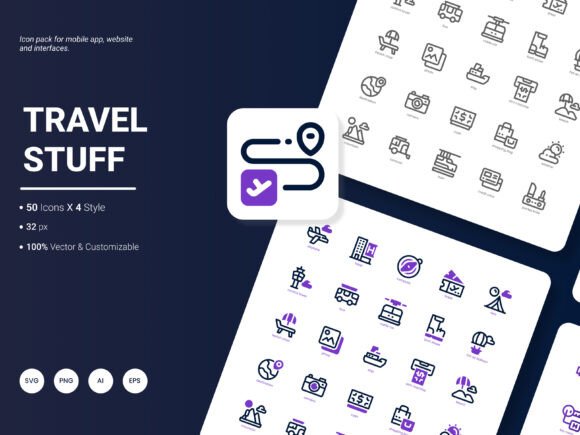
At its core, this collection provides 200 icons that represent widely recognized travel themes—transportation, accommodation, landmarks, navigation, luggage, and hospitality services. Unlike generic multipurpose icon sets that attempt to cover every conceivable category, the Travel Stuff Icon Pack narrows its scope to one thematic area, which creates a tighter visual language across all 200 assets.
The pack ships across six file formats: AI, EPS, SVG, PNG, PDF, and JPG. This range matters because different workflows demand different starting points. A UI designer building a mobile app interface typically reaches for SVG files for their scalability and small footprint. A presentation designer embedding icons into slide decks often prefers PNG files with transparent backgrounds. Meanwhile, print designers working on brochures or signage may need AI or EPS vectors for high-resolution output. The Travel Stuff Icon Pack covers all these bases without requiring users to convert files manually or compromise on quality.
Another distinguishing feature involves the four distinct styles available within the pack. Rather than locking users into a single visual treatment, the icons can be deployed across different aesthetic contexts—from refined and minimalist to more playful and illustrative, depending on the project's tone. This stylistic flexibility means a marketing team could use one style for a website while selecting a slightly different treatment for an accompanying infographic, maintaining brand consistency while adapting to each medium's demands.
Comparing Thematic Icon Packs Versus General-Purpose Libraries
Many designers default to massive icon libraries that offer thousands of assets spanning dozens of categories. These general-purpose resources—often subscription-based or bundled with design software—provide breadth. However, thematic packs like the Travel Stuff Icon Pack offer a different value proposition: depth within a specific domain.
When a project centers on travel content, a general library might yield 30 or 40 usable icons scattered across multiple style families. The Travel Stuff Icon Pack delivers 200 icons conceived and executed as a unified whole. This cohesion reduces the visual fragmentation that can occur when pulling assets from disparate sources. Every icon shares proportional consistency, stroke weight where applicable, and a common design philosophy. For a travel booking platform, a tourism board website, or an airline's mobile application, this internal harmony translates into a more polished user experience.
The tradeoff is clear. A thematic pack excels within its domain but offers nothing for unrelated categories. A design team working across healthcare, finance, and education projects would need multiple specialized packs or a comprehensive library. The Travel Stuff Icon Pack works best when travel constitutes a significant portion of the visual content, not an occasional footnote.
Strengths That Shape Practical Decisions
Editability stands out as a practical advantage worth examining closely. The inclusion of AI and EPS formats means users can open the icons in vector editing software and modify individual elements without degrading quality. Need to adjust the color of an airplane icon to match a brand palette? Want to remove a detail from a suitcase graphic for a simpler version? Editable source files make these adjustments straightforward. For teams that customize assets extensively before deployment, this capability shortens revision cycles and reduces dependency on original creators.
The format spread also supports cross-functional workflows. Consider a scenario where a content team produces a travel guide PDF, a web team builds an interactive trip planner, and a social media manager creates promotional graphics. Each person accesses the same icon set but pulls different formats suited to their tools. The SVG works in Figma or Sketch. The PNG drops into Canva or PowerPoint. The AI opens in Illustrator for high-fidelity print adjustments. This interoperability across tools and platforms minimizes friction in collaborative environments.
Popular content coverage is another factor. The 200 icons map to services and concepts that travel audiences regularly encounter—think hotel bookings, flight statuses, passport control, currency exchange, road trips, and beach holidays. When icon sets miss common travel scenarios, designers resort to improvising with unrelated metaphors, which can confuse users. A comprehensive thematic scope reduces the need for workarounds.
Where the Travel Stuff Icon Pack May Fall Short
No resource suits every situation, and acknowledging limitations helps designers make clearer choices. The Travel Stuff Icon Pack focuses exclusively on travel themes. Projects with minimal travel-related content gain little from a 200-icon set dedicated to that niche. A corporate intranet, an e-commerce store selling electronics, or a medical appointment app would find limited applicable assets here, making the investment harder to justify.
Style count, while generous at four variations, may not satisfy teams seeking extreme stylistic diversity. Some designers need ultra-minimalist line icons for one section and richly detailed illustrated icons for another. The pack's four styles provide meaningful range, but they exist within a coherent design framework. Teams wanting radical stylistic contrast across different sections might supplement with additional resources.
Additionally, while editability through AI and EPS formats is powerful, it assumes a certain level of vector editing proficiency. Users unfamiliar with Illustrator or similar tools may find themselves relying primarily on the raster formats—PNG and JPG—which limit customization to resizing and basic color overlays. The full potential of the editable advantage requires corresponding technical skills.
When the Travel Stuff Icon Pack Is the Right Choice
Certain project profiles align particularly well with what this collection offers. Travel and hospitality startups building their first website often operate with limited design resources. A ready-made, cohesive icon set eliminates the need to commission custom illustrations or piece together inconsistent free assets. The result is a more professional presentation during a critical launch phase.
Content creators producing travel guides, destination reviews, or itinerary planning tools benefit from the thematic focus. Because the 200 icons cover common travel concepts, creators spend less time searching for the right visual metaphor and more time assembling layouts. The consistency across icons also means repeated exposure reinforces a familiar visual vocabulary for returning visitors.
Agencies handling multiple travel clients represent another strong fit. An agency might use the Travel Stuff Icon Pack across several projects, repurposing and customizing assets for different brands. The editable vector formats support this kind of adaptation, making the pack a reusable toolkit rather than a single-use purchase.
Presentation designers preparing analytical reports or infographics for the tourism sector gain efficiency as well. Instead of hunting through disparate icon sites and dealing with inconsistent sizing or licensing terms, they access a uniform set that drops cleanly into slideware and data visualization tools.
When Exploring Alternatives Makes Sense
Some scenarios call for a different approach. Projects that span multiple industries benefit more from a broad, cross-category icon library, even if it means sacrificing the thematic depth a specialized pack provides. The tradeoff shifts from cohesive travel coverage to versatile general coverage.
Teams with access to in-house illustrators may prefer custom iconography that reflects their brand's unique personality. The Travel Stuff Icon Pack offers editability, but completely original work creates differentiation that even a well-executed pre-made set cannot match. Budget and timeline constraints often dictate whether customization is feasible.
Open-source icon sets present another path, particularly for projects with tight or nonexistent budgets. While free resources rarely match the style variety, format coverage, or thematic depth of a paid pack, they serve basic needs adequately. The decision often comes down to whether the time saved through a ready-made, multi-format collection justifies the cost relative to free alternatives that require more assembly effort.
How File Format Diversity Affects Workflow Integration
The six-format strategy of the Travel Stuff Icon Pack deserves closer attention because it directly impacts how smoothly icons integrate into different production pipelines. SVG files, for instance, function as code that browsers render natively. This makes them ideal for responsive web design where icons must scale from mobile screens to desktop displays without pixelation. PNG files, by contrast, provide fixed-resolution raster graphics that work reliably across virtually any software environment, from legacy systems to modern cloud-based tools.
AI and EPS vectors serve a different purpose altogether. They function as master files from which other formats derive. When a project requires significant modification—resizing individual elements, changing proportions, or altering visual details—starting from the vector source preserves quality through every edit. PDF inclusion adds another layer of convenience for teams that share design proofs or embed icons directly into document layouts.
JPG, while less common for icon work due to its lack of transparency support, remains useful for specific scenarios such as embedding in emails, social media posts with solid backgrounds, or quick previews where file size matters more than transparency.
This format breadth reduces the need for file conversion tools and the quality loss that sometimes accompanies format transitions. Designers who have wrestled with pixelated PNGs enlarged beyond their native resolution or SVG files that render inconsistently across platforms understand the practical value of having multiple starting points.
Editable Assets and the Customization Spectrum
Editability occupies a central role in how the Travel Stuff Icon Pack positions itself. The spectrum of icon customization ranges from "use as-is" to "completely redesign." Most projects fall somewhere in between. A common workflow involves taking the base icon, adjusting its color palette to match brand guidelines, and perhaps simplifying or emphasizing certain elements for clarity at smaller sizes.
The editable vector formats support this middle ground effectively. Without editability, designers face a binary choice: use the icon exactly as provided or commission something new. Editable files open a third path where the existing design serves as a strong foundation that can be tuned precisely to project requirements.
This capability matters most when icons appear prominently—in hero sections, feature highlights, or navigation elements where users view them repeatedly. Subtle mismatches in color temperature or stylistic detail become noticeable over time. Editable source files allow for harmony that pre-colored, non-editable raster images cannot achieve without advanced photo manipulation techniques.
Making an Informed Decision for Your Next Project
Evaluating the Travel Stuff Icon Pack alongside other options ultimately requires clarity about project parameters. Consider the thematic scope first. If travel content dominates the visual landscape, a specialized set provides efficiency and cohesion that general libraries cannot match. If travel represents only a small fraction of needed icons, a broader resource may prove more economical.
Consider the technical workflow next. Teams comfortable with vector editing software will extract more value from the editable AI and EPS files than those relying solely on drag-and-drop website builders. The format spread matters most when multiple team members use different tools to access the same asset pool.
Consider the stylistic requirements. The four styles included offer flexibility, but projects demanding highly specific or unconventional aesthetics should verify alignment before committing. Previewing sample icons helps gauge whether the visual language resonates with the intended audience and brand identity.
The Travel Stuff Icon Pack addresses a specific need with a thoughtful structure—200 thematically cohesive icons, multi-format delivery, editable source files, and stylistic variety. Its strengths shine brightest in travel-focused projects where consistency, efficiency, and cross-platform adaptability matter. Understanding both its capabilities and its boundaries allows design professionals to choose with confidence, whether that choice leads to this particular resource or to another solution that fits the unique contours of the work ahead.