The Role of Visual Tools in Mastering ASL Sign Language Deaf Mute Language
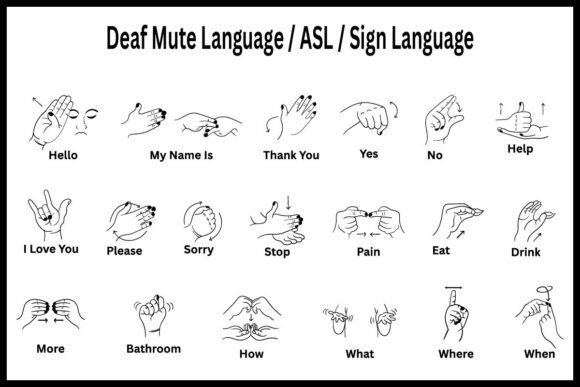
American Sign Language (ASL) serves as a vital bridge for communication among Deaf, hard of hearing, and nonverbal individuals. For learners, educators, and families entering this visual-spatial language, the quality of reference materials can make or break early progress. While live instruction remains irreplaceable, well-designed illustrated resources offer consistent, self-paced reinforcement of core vocabulary. This article explores how to evaluate ASL learning aids, what tradeoffs exist between digital and print formats, and how one specific vector illustration set addressing common ASL Sign Language Deaf Mute Language phrases can fit into a broader learning strategy.
Why Visual Clarity Matters in ASL Learning
Unlike spoken languages that rely on auditory cues, ASL depends entirely on handshape, movement, palm orientation, location, and facial expression. A static illustration must freeze a dynamic gesture into a single frame that still conveys all necessary elements. Low-quality images often compress fingers together, obscure palm orientation, or omit non-manual markers like raised eyebrows for yes/no questions. When learners refer to such images, they risk internalizing incorrect forms that later require unlearning.
For anyone teaching Deaf mute language skills—whether in a classroom, therapy session, or home environment—resources that prioritize anatomical accuracy and line clarity reduce misinterpretation. Clean, minimal line art avoids visual clutter, helping the eye focus on hand configuration and relative positioning. This is especially important for children, individuals with cognitive processing differences, and new parents learning to sign with a Deaf infant.
Comparing Learning Formats: Digital vs. Printable Resources
No single tool suits every learning style. Each format carries its own strengths and limitations, and smart learners often combine several. The table below outlines typical tradeoffs when choosing between digital apps, video libraries, and printable vector-based materials like the ASL illustration set under discussion.
Digital Apps and Video Platforms
- Strengths: Show motion, facial grammar, and real-time signing speed. Many include quizzes and spaced repetition.
- Limitations: Require screen access, internet connectivity, and sometimes subscriptions. Screen fatigue can reduce practice frequency.
- Best fit: Independent adult learners comfortable with technology; supplemental use alongside live practice.
Printed Flashcards and Wall Charts
- Strengths: Always available without batteries; tactile handling aids memory; can be posted in high-traffic areas for passive exposure.
- Limitations: Cannot show movement or three-dimensional depth; require high-quality source files to print clearly at various sizes.
- Best fit: Classroom environments, young children, and families who want constant visual reminders without extra screen time.
Editable Vector Files (AI, EPS, SVG)
- Strengths: Unlimited scalability; customizable colors, line weights, and layouts; can be embedded into lesson plans, apps, or websites without quality loss.
- Limitations: Require design software knowledge to fully customize; not a ready-to-use study tool out of the box.
- Best fit: Educators, content creators, and therapists who build individualized materials for diverse learners.
An effective ASL Sign Language Deaf Mute Language toolkit often includes a mix: videos for motion, a printable chart for daily reference, and an editable vector file for creating customized worksheets that target specific vocabulary gaps.
Key Features to Look for in Illustrated ASL Resources
When evaluating any illustrated guide—whether a free download or a premium vector pack—several attributes directly impact usability and learner success.
Scope of Vocabulary
Early-stage resources should cover high-frequency functional signs that enable basic needs and social connection. A set including greetings (Hello, Thank You, I Love You), essential requests (Help, Bathroom, Stop, What), and daily expressions gives learners immediate communicative power. Twenty carefully chosen signs can handle a surprising range of interactions when combined with pointing and context.
Design Language and Inclusivity
The visual style communicates more than the signs themselves. Professional line art with consistent stroke weight, clear finger separation, and neutral hand styling avoids stereotypes while remaining age-flexible. A modern, minimal aesthetic works equally well in an elementary classroom, a corporate diversity training handout, or a mobile app interface. Resources that feel clinical or childish can inadvertently limit their own adoption.
File Format Diversity
Practical application demands format flexibility. A resource delivered as a single flat PNG might work for one poster but becomes frustrating when you need to isolate a single sign for a flashcard. Multiple file types—such as an editable AI file for full customization, an EPS for software compatibility, an SVG for web use, and a high-resolution transparent PNG for quick placement—signal that the creator understands real-world workflow. This versatility supports creating posters, infographics, digital learning modules, and printed brochures without re-purchasing or redrawing assets.
Productivity and Customization: A Closer Look at One ASL Vector Solution
To ground this discussion in a concrete example, consider a specific ASL Sign Language Deaf Mute Language illustration set currently available for educators and content developers. This collection includes 20 commonly used signs, each hand-drawn with precision vector lines to ensure clarity at any size. The included phrases span greetings, courtesies, and essential emergency or care expressions, making it a practical foundation for communication boards, classroom walls, and beginner lesson plans.
The packaging of this resource directly addresses the format tradeoffs mentioned earlier. By providing an Adobe Illustrator file, users gain full control to recolor hands to match brand palettes, adjust line thickness for accessibility needs, or extract individual signs into separate artboards. The EPS version extends compatibility to CorelDRAW, Affinity Designer, and other vector applications, while the SVG files slot neatly into website builders and e-learning authoring tools. The transparent PNG files, already rendered at high resolution, serve as an instant drag-and-drop solution for non-designers creating social stories, worksheets, or quick reference cards.
What makes this type of asset particularly valuable for bridging communication gaps is its emphasis on reusability. A speech-language pathologist might print a single "Help" sign on a student's desk, while a curriculum developer integrates the "I Love You" sign into a family engagement app. The same source file supports both use cases without degradation. This scalability aligns with universal design principles—creating one flexible resource that adapts to many accessibility needs rather than forcing users to cobble together mismatched images from various sources.
Determining the Right Resource for Your Context
Selecting among ASL learning materials involves more than comparing price points. Reflect on these contextual factors before committing to any tool.
- Learner profile: Young children benefit from large, simple images with minimal background distractions. Adults may prefer discreet reference cards that don't feel infantilizing. The same vector resource can be scaled and styled to match developmental and cultural appropriateness.
- Environment: A printed poster in a school hallway faces different durability and size requirements than icons used in a mobile app. Vector graphics future-proof the investment because they can be re-exported at any resolution without starting over.
- Integration needs: If you already use a learning management system or teletherapy platform, check whether you can import custom images. SVG or transparent PNG formats tend to be the most universally accepted across digital tools.
- Long-term flexibility: Starting with an editable file means that as your vocabulary needs grow, you can maintain visual consistency by adding new signs in the same style, rather than patching together mismatched assets.
Potential Limitations and How to Address Them
No static illustration can capture the full grammar of ASL Sign Language Deaf Mute Language. Directional verbs, classifiers, and complex syntactic structures require video models or live interaction. Illustrations work best for foundational lexical items—single signs that anchor sentences. Pairing a reliable vector set with a structured ASL course, Deaf mentor sessions, or video dictionaries creates a more complete learning ecosystem.
Additionally, regional variations exist in ASL, just as dialects vary in spoken English. A sign commonly used on the West Coast may differ slightly from its East Coast counterpart. Any standardized illustration set represents one accepted variant. Learners should stay open to alternative signs encountered in their local Deaf community and use static resources as a starting point rather than an exhaustive authority.
Practical Applications Beyond the Classroom
The use cases for a clean ASL illustration pack extend well beyond traditional education. Healthcare settings increasingly adopt visual communication boards so patients who sign can express needs when an interpreter isn't immediately available. A set covering phrases like "Bathroom," "Help," and "Stop" becomes immediately practical in emergency rooms, dental offices, and senior care facilities. Workplace inclusion initiatives can incorporate these graphics into safety briefings, break room signage, or diversity training materials to normalize visual communication.
Digital product designers building accessibility-first applications can embed the SVG versions of these signs into user interfaces, offering an alternative communication channel for Deaf users. Bloggers and content creators writing about ASL Sign Language Deaf Mute Language can illustrate articles with consistent, professional graphics that respect the community they're discussing. Each application requires slightly different formatting, reinforcing the value of a multi-format resource that doesn't lock users into a single output.
Making an Informed Decision
Ultimately, the effectiveness of any ASL illustration set depends on how it's deployed. A beautifully designed vector pack sitting unused on a hard drive adds no value. Consider starting with a small, high-quality set of essential signs, testing it in your specific environment, and noting what works and what's missing. This incremental approach prevents over-investment in resources that don't match your reality and keeps the focus on communicative progress rather than collecting materials.
When evaluating options, prioritize transparency from the creator about what's included, file compatibility, and licensing terms—especially if you intend to use the graphics in commercial products or widely distributed educational materials. A resource that combines clear, accurate ASL Sign Language Deaf Mute Language illustrations with genuinely flexible file formats can serve as a long-term foundation piece in any inclusive communication toolkit.